Subscription pricing looks like a number on a screen. In practice it is a sequence of decisions: what is free, when the paywall appears, how long the trial lasts, and what happens when someone tries to leave. Get the sequence right and a modest price converts. Get it wrong and even a generous free tier produces refund requests.
We have watched small app teams copy the pricing page of a much larger product and wonder why it does not work. The maths is different at every scale, and the store takes its share before the money reaches the bank. This guide covers the shapes that work in 2026 and the traps that show up after launch.
The three subscription shapes
Most apps choose between a hard paywall, a metered free tier and a free trial. A hard paywall asks for payment before any real use. A metered tier gives a fixed amount of value, then asks. A trial gives full access for a set number of days and converts automatically unless cancelled.
Each shape sends a different signal. A hard paywall says the product is confident and the audience already knows why they need it. A metered tier says the product is useful in small doses. A trial says the value takes time to appear. The mistake is choosing a shape because a competitor uses it rather than because it matches how the product delivers value.
When a hard paywall works
A hard paywall works for utility apps with a clear, repeatable job: a scanner, a password manager, a professional calculator. The user arrives with intent, the store listing has already explained the outcome, and the price is small relative to the task. In that case a free tier can add support cost without adding conversion.
It fails for apps that need to build a habit before the value is obvious. A journaling app, a photo editor or a language course usually needs a free path to the first result. Asking for money before the user has felt the benefit turns a curious install into an uninstall.
Trials, discounts and the refund wave
A seven-day trial is not automatically better than a three-day trial. The right length is the time it takes a real user to reach the first meaningful result plus a little breathing room. Too short and people never see the value; too long and they forget the subscription exists until the charge arrives.
Discounts pull forward conversions and push up refunds. A large first-year discount attracts people who are buying the discount, not the product. When the renewal arrives at full price, a predictable share of them cancel and ask for their money back. A smaller, honest introductory offer usually produces a healthier second year.
A trial is a promise about time. If the product cannot prove itself inside that window, a longer trial only delays the cancellation.
Pricing tiers and the decoy problem
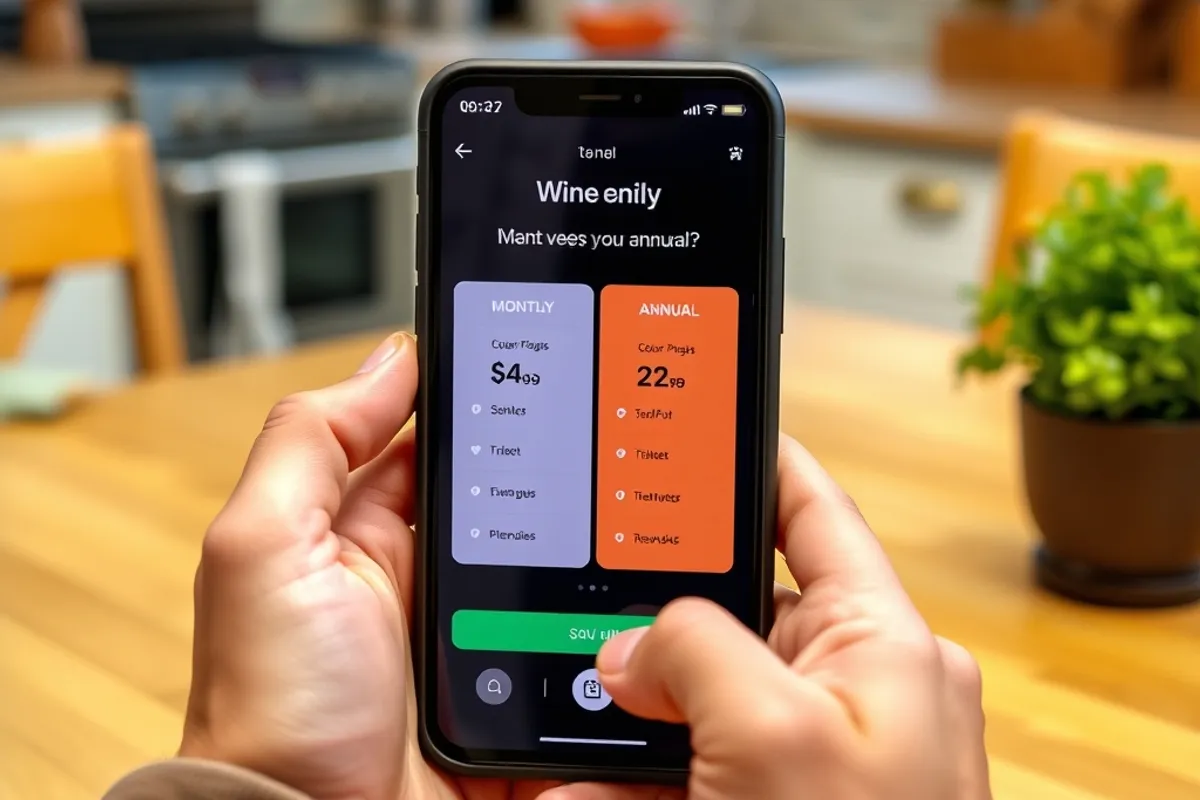
Three tiers are common because they anchor a choice, but the middle tier only works if the difference is legible. If the cheap plan is unusable and the top plan is bloated, the middle becomes the obvious pick and the other two become decoration. That can be effective, but it is also easy for a user to feel manipulated once they understand it.
Name tiers by the person they serve, not by a metal or a colour. A solo plan, a team plan and a business plan tell a clearer story than basic, pro and enterprise. Keep the feature list short enough to compare without a spreadsheet, and put the one difference that matters at the top.

Store fees, tax and net revenue
The price a user sees is not the money the developer keeps. App store commissions, local taxes and payment processing come out before the payout, and the rates vary by region and by program. A one-dollar subscription can net meaningfully less than a dollar, especially after currency conversion and a refund.
Model the net revenue per subscriber before you set the price, not after the first payout. Include the store fee, the tax treatment in your main markets, the expected refund rate and the cost of support. A price that looks healthy at gross can be thin at net, and the difference decides whether paid acquisition is viable.
Churn signals before the cancel button
People rarely cancel on the day they stop using an app. They stop opening it, then cancel when the renewal reminder arrives. Watch the gap between last active day and renewal date. A growing gap is an early warning that the product has lost its place in the routine.
Also watch failed payments, downgrade requests and support messages about billing. Each is a cheaper signal than a cancellation, and each can be addressed with a clearer email or a simpler plan. A cancellation survey is useful, but by then the decision is already made.
- Track trial start, first value moment and trial-to-paid conversion separately.
- Compare refund rate by acquisition source, not just overall.
- Measure net revenue after store fees and tax, per market.
- Watch the active-to-renewal gap as an early churn signal.
A pricing test you can run this quarter
Change one variable at a time: the trial length, the price of the middle tier or the moment the paywall appears. Run it for a full billing cycle so renewals and refunds are included, not just first charges. Keep the version that improves net revenue without raising refunds or support load.
For the first-session experience that decides whether a trial converts at all, read our guide to mobile app onboarding. For the hosting and billing systems behind the app, see our Cloud Computing section.